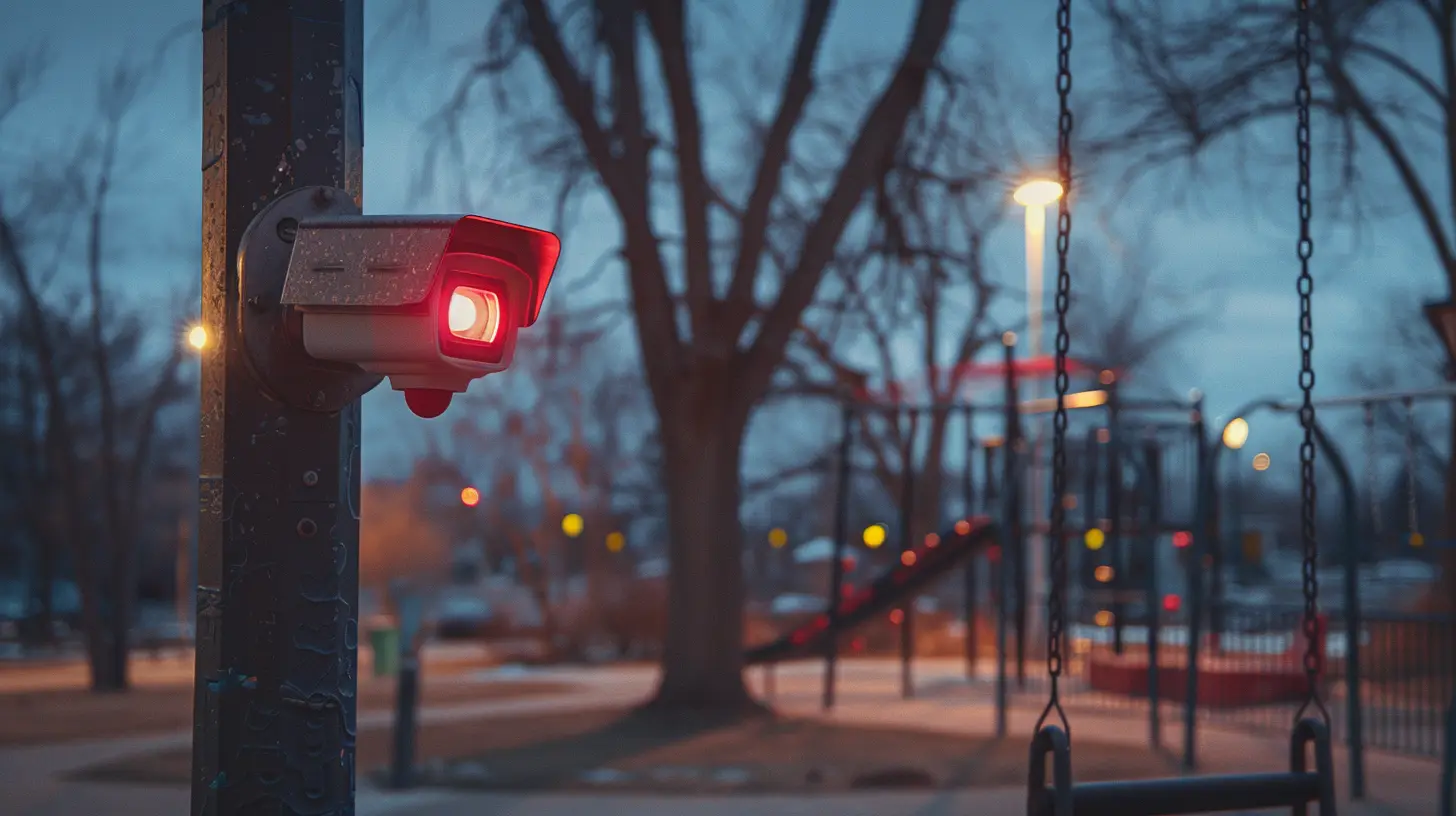
Growing up, I remember hearing some version of the same line anytime the subject of government power came up. We are not China. China puts cameras on every corner and tracks its citizens everywhere they go, and we do not do that here, because we have rights and courts and a Constitution that says the government cannot just watch you all the time for no reason. It was less a policy position than a kind of national identity marker. Whatever else was wrong with the country, at least we were not that.
I think about that line every time I drive past one of the small, solar powered cameras that have gone up on poles around town over the past couple of years. They are called Flock Safety cameras, after the company that makes most of them, and there is a good chance you have driven past a few dozen without noticing. They started out as automated license plate readers, a fairly narrow and defensible tool: point a camera at the road, read plates, check them against a list of stolen cars. That is not really what they are anymore. The gap between what most people assume these cameras do and what they actually do, who gets to look at the footage, and what happens when the system gets it wrong, is worth walking through in full.
Not Just License Plates Anymore
Flock Safety was founded in Atlanta in 2017 by Garrett Langley, after he was the victim of a property crime and learned firsthand how little police could do without solid evidence. That origin story matters, because it explains how fast this grew: it started as a real product aimed at a real, sympathetic problem. Today the company says it operates in more than 5,000 communities across 49 states and performs upward of 20 billion vehicle scans every month. Flock was valued at $8.4 billion in an April 2026 funding round, up from $7.5 billion the year before and $3.5 billion in 2022, with backing from investors including Andreessen Horowitz and Tiger Global. It is worth knowing where that growth actually started, too. By the company’s own account, homeowners associations still make up roughly 40 percent of Flock’s entire business, not police departments. This did not begin as a policing tool that expanded into neighborhoods. It began as a neighborhood product that expanded into policing.
Calling these devices license plate readers undersells what they do now. Flock’s own marketing calls it a Vehicle Fingerprint: beyond the plate itself, the cameras log a car’s make, model, color, roof racks, bumper stickers, dents, and wheel style, in enough detail that an officer can search for something like a blue sedan with damage on the left side and get a result with no plate number at all. A feature called Convoy Analysis flags vehicles that keep appearing near each other, effectively mapping who tends to travel with whom. Flock’s Condor camera line goes further still, built specifically to track people rather than cars, with the ability to pan, tilt, and zoom automatically toward anyone who walks into frame. The company has also branched into gunshot detection and a drone program it calls Drone as First Responder, which dispatches an automated drone to a scene ahead of any officer. None of that is speculative. It is the current product line, which is why a company that started out reading plates now markets itself as running what it calls a Real-Time Crime Center.
When the System Gets It Wrong
This stops being an abstract privacy debate fast. In a report published this month, the Institute for Justice, a civil liberties legal nonprofit, documented at least 26 cases since 2018, the majority since 2023, in which an ALPR error led directly to an innocent person being pulled over, detained at gunpoint, or jailed. In nearly two out of every three of those cases, officers did not realize the mistake until after they had already drawn their weapons.
The individual cases are hard to read past. A Flock camera misread an O as a zero, and officers detained two grandparents at gunpoint while their three year old granddaughter watched from the back seat. A different Colorado driver was pulled over repeatedly after her plate was mistakenly added to a Flock hotlist, with officers unable to pin down the cause for some time. In Sherwood, Arkansas, a misread SUV plate led officers to detain an innocent couple at gunpoint while their six week old baby sat alone in the back seat. Just weeks ago, in a case reported by FOX 9 in Minnesota, a Flock system dropped a digit from a car reviewer’s plate, turning “3410 DTM” into “34 DTM,” a near match to a plate reported stolen elsewhere in the country. Four Plymouth, Minnesota officers surrounded him with hands resting on their holsters before the mistake got sorted out.
The scale behind these errors makes them less surprising than they should be. Flock has said its cameras read plates correctly about 93 percent of the time. Applied to the company’s own claimed volume of 20 billion reads a month, that still works out to well over a billion misreads monthly. A separate, independently run randomized controlled trial in Vallejo, California, cited by the Brennan Center for Justice, found that 35 to 37 percent of ALPR hits from both fixed and mobile readers were flat out misreads, a striking number given that a single hit can be enough to trigger a stop at gunpoint. In one widely covered Colorado case, a mother and her family, including her six year old daughter, were pulled over and forced to lie face down on hot pavement in Aurora after a system mistook their plate for a stolen motorcycle registered in a different state entirely. The city eventually paid $1.9 million to settle that case.
None of this requires anyone to act in bad faith. It mostly just requires a camera misreading a smudged, tilted, or angled plate at highway speed, and a human being downstream who treats that misread as settled fact.
Cameras at the Playground
This part sounds like an exaggeration until you see the paper trail, because it is not an isolated incident. It is a pattern.
In December 2025, a technologist and YouTuber named Benn Jordan discovered, and reported jointly with 404 Media, that at least 60 of Flock’s Condor cameras, the model built specifically to track people, had been left exposed on the open internet with essentially no security. Anyone who stumbled onto them could watch the live feed and pull up 30 days of archived footage. Jordan found these cameras aimed at a parking lot, a bike path, a stoplight, and a children’s playground. He told 404 Media the playground affected him most, since the footage showed unattended kids that anyone online could view and, if they chose to, run through publicly available facial recognition tools. Flock’s response called it a limited misconfiguration affecting a very small number of devices.
That was not the only children’s space story. In Dunwoody, Georgia, a resident used public records requests to learn that Flock’s own sales staff had been logging into cameras in sensitive locations, including a children’s gymnastics room and a swimming pool at a local Jewish community center, in order to run live product demonstrations for prospective police department clients elsewhere in the country. Nobody hacked anything. This was ordinary, authorized company practice: watching kids in a gymnastics class to close a sale somewhere else. Flock’s CEO personally apologized and called it poor judgment. The city council renewed its Flock contract anyway, after roughly three hours of public objection at a single meeting.
Separately, ordinary residents around the country have started posting their own videos asking a much simpler question: if these cameras exist for traffic enforcement, why are so many of them pointed directly at playgrounds. The official explanation, that parking lots and access roads near parks see a lot of car break-ins and similar property crime, is defensible on its own terms. It just was not the pitch anyone remembers hearing when these systems were first sold as tools for catching stolen cars on the highway.

Garbage Trucks, HOAs, and the Slow Creep
Once a piece of surveillance infrastructure exists somewhere, it tends to get repurposed for whatever the next department with a budget wants it for. Two examples make that concrete, and neither one involves Flock directly, which is itself the point: this is now a whole category of technology, not one company’s product.
Start with your garbage truck. Dallas, Huntsville, and Cape Coral have each either approved or seriously weighed mounting AI cameras on sanitation trucks specifically to catch code violations like overgrown grass, illegal dumping, and graffiti as the trucks make their normal rounds. Dallas signed off on a $2.55 million, three year contract to outfit 100 trucks, with each flagged violation assigned a blight score for staff to review. Huntsville put a similar plan on hold after residents raised privacy and cost concerns at a council meeting. Stockton, California already runs a comparable system, and its early numbers are worth sitting with: nearly 200,000 images captured, close to 40,000 parcels analyzed, and roughly 14,000 individual issues flagged so far. That is not a limited trial. Over time it adds up to a continuous visual record of tens of thousands of individual properties, produced simply because a truck that was already driving the route happened to be recording along the way.
Now your HOA, which comes with a genuinely uncomfortable wrinkle attached. In Sarasota County, Florida, the Laurel Oak Estates HOA started using automated cameras and speed sensors to fine anyone driving through the neighborhood too fast, resident or not, with tickets running $75 to $200. Florida law caps HOA fines at $100 per violation. The HOA never checked with the county sheriff’s office about the legality of any of this before rolling it out, and the sheriff’s office said in turn that it considers the whole arrangement none of its business, since a private HOA fining program has nothing to do with actual law enforcement. The vendor behind those particular cameras, a company called Traffic Logix, markets directly to HOA boards, and its own pitch to those boards is fairly blunt about the financial upside: the fines generated, it notes, can help fund other HOA programs. More than 400 HOAs nationwide already use similar systems. This is not a fringe use case for Flock either. As mentioned above, HOAs account for close to 40 percent of the company’s total business, and Flock markets gunshot detection and vehicle tracking to homeowner boards using nearly the same language it uses when pitching police departments.
Neither the garbage truck nor the HOA camera was ever put to a vote by anyone who actually has to live under it, the way a new ordinance or a new sheriff would be. A truck route stayed the same and picked up a camera. A board signed a vendor agreement at a meeting most residents skipped. Now there is a standing visual record of your yard, your car, and your driving speed, generated by equipment nobody asked you about directly.
Does Any of This Actually Work
This is the fair question, and the honest answer is messier than either side of the debate tends to admit.
Flock has repeatedly funded and published research claiming dramatic results, including a claim that got wide pickup: that its technology plays a meaningful role in resolving roughly one out of every ten crimes reported nationwide, alongside separate marketing claiming individual communities have seen crime drop by 70 percent or more after installing its cameras. Those figures trace back almost entirely to surveys Flock itself commissioned among its own customers, not to independent audits. Coverage of the underlying methodology found that the academic researcher involved acknowledged the police department data he received was too uneven and incomplete to support any rigorous statistical conclusion, shortly before Flock nonetheless promoted a specific double digit headline number drawn from that same research. Flock also credits the technology with improved homicide clearance rates in cities including Tulsa and Cobb County, Georgia, and individual departments genuinely do report real stolen vehicle recoveries and real leads in missing persons cases. Those successes are not nothing. But there is currently no fully independent, methodologically rigorous study confirming the scale of benefit the company advertises, and there is real, independently gathered evidence, like the Vallejo misread rate above, cutting the other direction.
Take that 10 percent figure at face value anyway, just for a moment, because the arithmetic behind it is worth doing in the open. The FBI’s own 2024 crime data counted roughly 7.2 million violent and property crimes reported nationwide that year. Ten percent of that is about 720,000 crimes a year where Flock is claiming some role. Set that next to the company’s own claimed scan volume of more than 20 billion vehicle reads a month, or roughly 240 billion a year, and the ratio comes out to somewhere around 330,000 scans of ordinary people’s cars for every single crime the company says its technology helped address. For scale, total crime clearances across every method and every agency in the country, in a typical recent year, land somewhere around 1.5 million. If Flock’s own number is taken literally, the company is claiming a hand in something close to half of all crime clearances in America, entirely on the strength of a survey it commissioned about itself.
Put simply, the technology clearly helps close some cases some of the time, and that genuinely matters to the people involved. But a company that has to scan a few hundred thousand innocent vehicles to plausibly claim credit for one crime is not fundamentally a crime-solving tool that happens to collect a lot of data as a side effect. The data collection is the actual product. Solving 10 percent of crime, if the number even holds up, is what that data collection occasionally produces along the way. Whether that trade is worth the volume of false positives, the scope of what gets collected on people who were never suspects, and where all of that data quietly ends up, is a genuinely separate question, and one the company’s own marketing has an obvious financial interest in never answering honestly.
Who Else Gets to Look
This is the part that should worry people no matter their politics, because it has already cut across the political spectrum in practice.
Flock does not hold a formal contract with ICE. It has not needed one. Reporting from 404 Media found more than 4,000 lookups performed inside Flock’s nationwide network by local and state police at the informal request of federal immigration authorities, with officers logging search reasons like immigration, ICE, and ICE warrant directly into the system. Separate reporting found that Customs and Border Protection had backdoor access to more than 80,000 Flock cameras nationwide through what Flock initially described as a narrow pilot program. A letter from Senator Ron Wyden, released in October 2025, revealed that a division of ICE, the Secret Service, and the Navy’s criminal investigation division had all separately accessed Flock’s nationwide network, with ICE’s Homeland Security Investigations division alone running nearly 200 searches. Wyden’s conclusion was blunt: he said he no longer believes Flock is willing or able to prevent this kind of abuse, and he has advised local officials that removing the cameras is the only safeguard he trusts.
It gets more specific than immigration enforcement, too. Researchers with the University of Washington Center for Human Rights documented a Texas police officer using Flock’s nationwide search tool to try to locate a woman who had self-administered an abortion, drawing on data generated by ALPR networks in Washington state, a state that protects abortion access, in support of a case tied to a state that does not. Separately, research from the Electronic Frontier Foundation found that law enforcement had run hundreds of Flock searches connected to political protest activity, including demonstrations tied to nationwide anti-Trump organizing. A camera network pitched to a city council as a tool for catching car thieves has, in real documented practice, helped identify people who showed up to a protest and helped one state’s laws reach across the border into another state’s residents.
Flock’s public response to all of this is that federal sharing is off by default, that individual agencies control their own data, and that the company has added new toggles and audit requirements over the past year specifically because of this reporting. Those changes are real and worth acknowledging. They also arrived only after journalists surfaced the problem, not before, and a growing list of cities, more than 80 by one recent count, have canceled or suspended their contracts since the start of 2025 rather than take the fix on faith.
What It Does to People Just Knowing
Set the specific misuse cases aside for a moment, because there is a cost here that shows up even when the system works exactly as it was designed to.
Researchers have studied what is usually called the chilling effect for decades, long before AI cameras entered the picture: the tendency of people to quietly narrow their own behavior once they believe they are being watched, even when they have done nothing wrong. Legal scholar Jon Penney, in work summarized by the Citizen Lab, found that after the Snowden revelations about NSA surveillance, ordinary people measurably pulled back from engaging with sensitive topics online, not because they were doing anything illegal, but simply because they now knew it was possible to be watched. A 2025 study on surveillance and self-regulation found the same basic pattern in physical, camera-monitored spaces: people who believe they are actively being watched report more anxiety and impose more restraint on their own behavior, regardless of whether anyone is actually reviewing the footage at that moment. Legal scholar Daniel Solove has compared this kind of low-grade, pervasive surveillance to environmental pollution, a background condition that quietly narrows what people feel free to do, say, or even where they feel free to drive, without ever needing to punish a single person directly.
That is the piece that gets lost in a debate mostly conducted in the language of stolen vehicle recoveries and clearance rates. A surveillance network does not need to falsely accuse anyone in particular to change how people live underneath it. It only needs them to know it is there.
To Be Fair
None of this means the underlying goal is illegitimate, and it would be dishonest to argue otherwise. Most police departments genuinely are stretched thin relative to their caseloads, and less than half of violent crime reported in this country gets solved at all. A tool that hands an overworked detective one more real lead, one more recovered stolen car, one more located missing child, is addressing a real problem, not a manufactured one. Most communities that adopt this technology do so with genuine public support, often in the wake of a specific local crime problem, and at least one federal court, in a case out of Norfolk, Virginia, has held that a camera network of this kind does not violate the Constitution on its face. The people running most of these programs at the local police department level are not trying to build a surveillance state. They are trying to close cases with the staffing and tools they actually have in front of them.
We Said We Weren’t China
So back to that line I grew up hearing. It is not literally true that a patchwork of more than 5,000 separate local contracts with a single private vendor amounts to the same thing as a centralized state surveillance apparatus built to track ethnic minorities and political dissidents, and it would be sloppy to argue otherwise. The differences in intent, structure, and who is ultimately accountable are real and matter.
But I am no longer sure that distinction is doing the work it used to. A camera network that federal immigration agents can already search informally, that has already been used to help one state investigate a woman for something legal in the state where she stood when she did it, that has already logged hundreds of searches tied to political protests, and that a sitting United States senator says the vendor is neither willing nor fully able to secure, is not something I was raised to believe could happen here without a real debate, a vote, or at least a law passed on purpose. Instead it arrived one HOA contract, one garbage truck pilot, and one quiet city council vote at a time, and most of the country is only learning the scope of it after the fact, the same way Dunwoody only learned its kids’ gymnastics class had doubled as a sales demo once someone finally filed the records request.
I do not think the answer is pretending the crime problem behind all of this is imaginary. I think the answer is the boring kind of fix that never trends: real audits run by people who do not work for the vendor, a hard legal wall between local ALPR data and federal immigration enforcement, real consequences when a misread plate ends with a gun drawn on an innocent family, and city councils that get to make a decision about this and have it actually hold, unlike Cleveland’s did. That is not a radical ask. It is just the version of oversight we always said was the entire reason we were not the country with a camera on every corner.
Sources
What Flock Safety cameras actually do
- Flock Safety, Wikipedia, background, scale, and controversy timeline
- Flock Safety revenue, funding and growth, Sacra, including the HOA share of Flock’s business
- Flock Safety’s Private Surveillance State, State of Surveillance, valuation and contract cancellation tracking
False positives and wrongful stops
- Dozens of Innocent Motorists Have Been Pulled Over, Detained at Gunpoint, or Jailed Due to AI License Plate Camera Errors, Institute for Justice
- When license plate readers get it wrong, CBS News
- Flock camera error leads to Minnesota car reviewer being swarmed by cops, FOX 9 Minneapolis-St. Paul
- Automatic License Plate Readers: Legal Status and Policy Recommendations, Brennan Center for Justice, including the Vallejo, California misread study
Cameras at playgrounds and other sensitive locations
- Flock camera captured kids on a playground, Straight Arrow News via Yahoo
- City Learns Flock Accessed Cameras in Children’s Gymnastics Room as a Sales Pitch Demo, Renews Contract Anyway, 404 Media
Garbage trucks and HOAs
- AI cameras on Dallas trash trucks to spot violations, NBC 5 Dallas-Fort Worth
- Your Garbage Truck Is About to Start Spying on You, including the Stockton, California case study
- HOAs’ Speed Cameras Raise Legal Questions, Florida Realtors
Effectiveness claims
- Studies Show Flock’s ALPRs Reduce Crime, So Long As Flock Controls the Inputs and the Methodology, Techdirt
- Flock Safety funding announcement citing homicide clearance claims, Flock Safety
- FBI Releases 2024 Reported Crimes in the Nation Statistics, Federal Bureau of Investigation, used for the scans-per-crime calculation
Federal and law enforcement data access
- ICE Taps into Nationwide AI-Enabled Camera Network, Data Shows, 404 Media
- CBP Had Access to More than 80,000 Flock AI Cameras Nationwide, 404 Media
- Leaving the Door Wide Open: Flock Surveillance Systems Expose Washington Data to Immigration Enforcement, University of Washington Center for Human Rights
Psychological effects of surveillance
- Chilling Effects in the Digital Age, The Citizen Lab, on Jon Penney’s research
- Surveillance as a Socio-Technical System: Behavioral Impacts and Self-Regulation in Monitored Environments, 2025 study