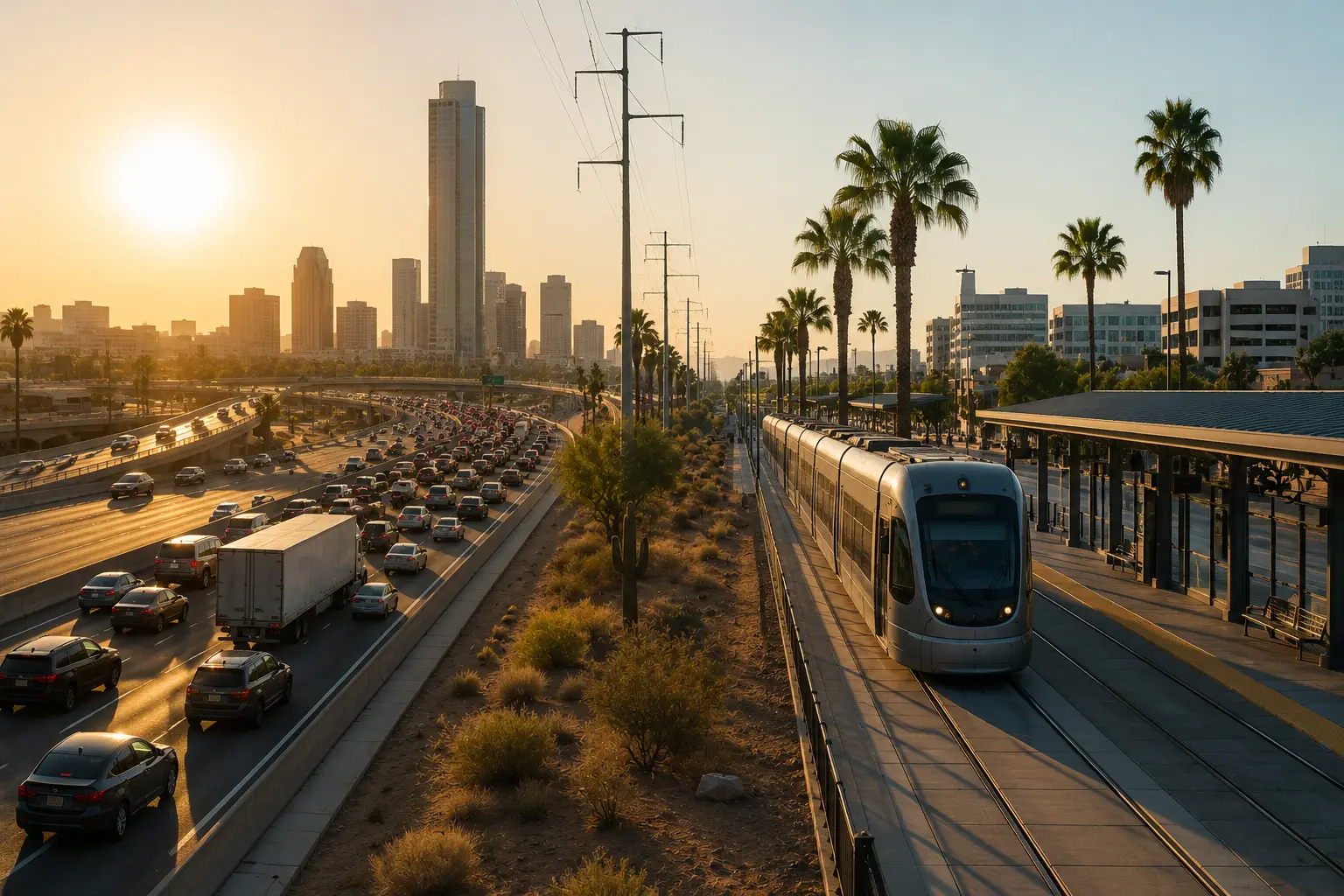
A drive down the I-35 frontage road in Austin says more about American transportation policy than any congressional hearing ever could.
I was driving down the I-35 frontage road near downtown Austin last week when it really hit me. Block after block, the land had been scraped clean. Buildings gone. Chain link fencing around dirt lots. Crews were already staging equipment for the next phase of the highway expansion, tearing through neighborhoods that have stood for generations.
Then I thought about Project Connect, Austin’s light rail plan that voters approved back in 2020. Six years later, not one foot of track has been laid.
That contrast, between how fast we can clear land for a highway and how long it takes to get permission to lay a single rail tie, is the transit funding gap in a nutshell. It’s the enormous, mostly invisible difference in how easily money and political permission flow toward highways compared to how hard both are to come by for mass transit. Nowhere is that gap more obvious than in the car-focused Sunbelt, where cities like Austin are growing faster than almost anywhere else in the country and building their future around the automobile at the same time.
This isn’t a story about which mode of travel is objectively better. It’s a story about which one gets a green light almost automatically, and which one has to fight for years, sometimes decades, for the same privilege.
A Tale of Two Projects, Eight Miles Apart
Start with the highway. TxDOT’s I-35 Capital Express Central project will rebuild eight miles of interstate through the heart of Austin: tearing out the old upper decks, lowering the mainlanes, and adding two non-tolled managed lanes in each direction. The agency priced the project at $4.5 billion when it released its draft environmental review in 2022. By the time it broke ground in October 2024, its own figure had climbed to $5.6 billion.
To build it, TxDOT’s own count puts 111 homes and businesses in the project’s path, including five single-family houses, 46 apartment units, and 59 businesses, everything from a diner that’s been open since 1966 to health clinics that serve uninsured patients. More than 54 acres will be absorbed into the state’s right of way. TxDOT never needed a single voter’s permission to do any of this.
That doesn’t mean nobody tried to stop it. A coalition that included Rethink35, Save Our Springs Alliance, Environment Texas, PODER, the Austin Justice Coalition, and several neighborhood associations sued TxDOT twice, filed a federal civil rights complaint, and organized rallies that drew hundreds of people. Austin’s City Council passed a resolution asking TxDOT to pause construction. Travis County Commissioners asked for more thorough studies. In TxDOT’s own public comment periods, a large majority of respondents, at different points 75 percent and later closer to 87 percent, opposed the project outright.
None of it slowed the project down in any meaningful way. Construction on two of the three Capital Express segments actually broke ground ahead of schedule, in the face of that opposition. TxDOT has since filed condemnation lawsuits against property owners who wouldn’t accept its offers, using its legal authority to take possession of land while compensation disputes play out separately in court.
Now look eight miles away, at Project Connect. Austin voters said yes to a light rail system in November 2020, the third time the idea had been on a ballot after failed attempts in 2000 and 2014. The plan promised close to 28 miles of light rail for about $5.8 billion, part of a larger $7.1 billion package that also funded bus and commuter rail upgrades.
Two years later, in 2022, that rail estimate had very nearly doubled to $10.3 billion. Land costs had surged along with Austin real estate values, and the planned downtown tunnel turned out to need to run more than four miles instead of the original mile and a half, which alone pushed its cost from $2 billion to $4.1 billion. By the summer of 2023, the Austin Transit Partnership cut the whole project down to size: 9.8 miles instead of 28, 15 stops instead of 26, no tunnel, and no direct airport connection. Projected daily ridership fell from 70,000 riders to 34,000.
Even after all that shrinking, the price tag barely moved. The current 9.8-mile starter line is expected to cost somewhere between $7.1 billion, the Austin Transit Partnership’s preferred number, and $8.2 billion, the figure that shows up on the Federal Transit Administration’s own dashboard. Either way, that works out to roughly $725 million to $840 million per mile, making it the most expensive transit project per mile in Texas history and the seventh most expensive light rail line per mile out of 34 tracked nationally by NYU’s Marron Institute of Urban Management.
As of this spring, not one foot of that track has been laid. Construction isn’t expected to start until 2027. The line isn’t expected to open until 2033: thirteen years after voters approved it, and thirty-three years after Austin first tried and failed to build something like it.
The Transit Funding Gap Isn’t Bad Luck. It’s How the System Is Built.
It would be easy to read that comparison and conclude that TxDOT is simply more competent than the Austin Transit Partnership, or that Texans quietly prefer highways to trains. Neither is really true. What’s true is that the two projects were never playing by the same rules.
Start with federal money. Since 1956, the federal government has funded most road construction through the Highway Trust Fund, paid for by the gas tax and a handful of related fees. In 1982, Congress carved out a Mass Transit Account inside that same fund. On paper, a portion of newer tax revenue is split 80 percent to highways and 20 percent to transit. In practice, because older taxes and truck fees aren’t split that way, the Mass Transit Account has received something closer to 12 to 14 percent of total Highway Trust Fund revenue over the last decade, according to the Congressional Research Service. Highways get roughly 85 to 88 percent. That split exists before a single project anywhere in the country ever competes for a dollar.
The money that does reach state highway departments mostly flows through formula apportionment, a near automatic annual allocation that lets agencies like TxDOT plan multibillion dollar, multiyear capital programs with real confidence the money will show up. Big transit capital projects don’t get that certainty. They compete nationally through the Federal Transit Administration’s New Starts program, a multiyear, discretionary process with its own extended environmental review, its own project rating, and its own exposure to whatever posture the sitting administration wants to take on transit spending. The current Transportation Secretary has already directed the agency to weigh transit grant applications more strictly against a cost-benefit standard, one more layer of uncertainty stacked on top of everything Austin has already been through.
Then there’s the local funding fight, which highways simply don’t have to have. TxDOT never needed Austin voters to approve anything. Project Connect needed them to, and needed three tries over twenty years to get a yes. Even that yes hasn’t proven durable. Texas Attorney General Ken Paxton has spent more than two years challenging whether the Austin Transit Partnership’s bond financing is even legal, a fight that reached the Texas Supreme Court and produced a ruling this past May that sent the case back to a lower court without resolving the underlying question. “Nothing about this scenario is as it should be,” Chief Justice Jimmy Blacklock wrote of the procedural tangle, and the line captures the whole saga pretty well. Attorneys on both sides now openly describe the fight as having already cost the project two years.
Compare that to the highway’s paper trail. TxDOT’s final environmental review for Capital Express Central runs more than 18,000 pages of genuine, extensive documentation. But once that review was finished, nothing in it functioned as a real veto. Opposition, lawsuits, and even a formal city council resolution asking for a pause all turned out to be, in practical terms, optional for TxDOT to address.
Austin Isn’t a Special Case
If this were just an Austin story, it might be a fluke. It isn’t.
Nashville tried to build light rail in 2018 with a $5.4 billion plan called Let’s Move Nashville: roughly 26 miles of light rail plus bus rapid transit. Voters rejected it by a two-to-one margin after an opposition campaign led by Americans for Prosperity. It took Nashville until November 2024, six years and a change of mayors later, to pass any dedicated transit funding at all, and the plan that finally succeeded, Choose How You Move, doesn’t include a single mile of light rail. It’s buses, sidewalks, and smarter traffic signals, funded by a half-cent sales tax increase that voters approved by a two-to-one margin in the other direction.
This isn’t unique to red state Sunbelt cities either. Seattle’s Sound Transit, expanding light rail into West Seattle and Ballard, has watched its own cost estimates climb toward $30 billion, driven by some of the same forces at work in Austin: voters approving funding based on early, rough estimates before real engineering was done. Eric Goldwyn at NYU’s Marron Institute, who studies transit costs across the country, has pointed to exactly this pattern: cities ask voters to approve a price tag while only a sliver of the design work is finished, which all but guarantees the number will move once the real engineering starts.
Where the Sunbelt genuinely stands apart is in what happens after that vote. Sun Belt metro areas now account for roughly half of all population growth in the country, according to research from Rice University’s Kinder Institute for Urban Research, and they’re absorbing it into low-density development built almost entirely around the car. Kinder Institute director Bill Fulton put it simply: “The way Sun Belt cities are laid out, you’re just more dependent on cars.” That same research found Sun Belt residents face higher transportation costs, more pedestrian deaths, and lower per-capita transit ridership than the rest of the country, even in cities that have invested real money in transit over the past two decades.
Low-density sprawl doesn’t just make transit less convenient. It makes the math around it look worse. A mile of rail through a dense corridor can serve tens of thousands of daily riders. The same mile through Sunbelt sprawl serves far fewer, which hands ammunition to anyone looking to argue the whole thing is a waste, regardless of whether the underlying transit funding gap was ever fair to begin with.
To Be Fair to the Other Side
None of this means highways are free money or that transit’s critics are wrong about everything.
I-35 genuinely does carry freight and regional traffic that has nowhere else to go, and Central Texas has grown so quickly that the corridor really was falling apart under its own weight. Most of the region’s housing and jobs are already built in a pattern that assumes a car, and that pattern doesn’t reverse itself just because a rail line opens nearby. A single light rail starter line was never going to fix Austin’s traffic on its own.
The cost overruns on Project Connect are also real problems, not just political sabotage. Only about 5 percent of the system had actually been designed when voters approved it in 2020, according to an internal agency memo, which transit finance experts say all but guaranteed the price would move once real engineering started. Tunnels are expensive everywhere, not just in Texas. And taxpayers have every right to ask hard questions about whether a $7 to $8 billion price tag for under 10 miles of rail, serving a projected 34,000 daily riders, is money well spent, even if you think the process was stacked against transit from the start.
It’s also worth saying plainly that highways face real opposition too, opposition that just turns out not to matter as much once a project is underway. TxDOT genuinely did respond to thousands of public comments and produce an 18,000-page environmental review. That’s not nothing, even if it didn’t change the outcome.
What Would Actually Close the Transit Funding Gap
If the gap is built into the system, closing it means changing the system, not just wishing individual transit agencies would move faster.
A few places to start. Congress could stop pretending the Mass Transit Account’s 20 percent share is real when the actual number has run closer to 13 percent for years, and either commit to the honest number or fund transit through its own dedicated, formula-based stream the way highways are funded, rather than forcing every major transit project to compete individually for discretionary grants.
Cities and transit agencies could take a lesson from their own worst experiences and stop putting price tags in front of voters before real engineering is done. Nashville’s second attempt succeeded partly because it built a broad coalition first and made realistic promises it could actually keep. Austin’s 2020 vote might have avoided years of subsequent lawsuits over what voters actually approved if the number on the ballot had reflected a real design instead of a 5 percent sketch.
States could also close the legal gap. Once voters approve a highway budget or a transit budget, both ought to carry the same practical certainty. Right now a state DOT’s formula funding is nearly bulletproof, while a voter-approved transit measure can still be tied up in court for years over its financing mechanism. That asymmetry has nothing to do with which project is more worthwhile and everything to do with which one has better legal armor.
None of this requires taking money away from roads that genuinely need it. It requires being honest that highways and transit have never competed on a level field, and deciding, as a matter of policy rather than habit, whether that’s actually the outcome we want.
Back on the Frontage Road
I still think about that drive. Cleared lots where buildings used to stand, ready for a highway that will be finished, in some form, within a decade. A few miles away, a light rail line that Austin voters approved before some of today’s high schoolers could read, still tied up in court over whether its own funding is even legal.
Both projects say something true about how this country builds infrastructure. Highways move because the money moves automatically and the legal ground is settled before a shovel ever hits the dirt. Transit stalls because it has to win the argument over and over again: at the ballot box, in the legislature, and now in front of the Texas Supreme Court, all while the highway a few miles away just keeps rolling forward.
The transit funding gap isn’t an accident of engineering or a verdict on whether people in the Sunbelt want trains. It’s a policy choice, made decades ago and rarely revisited since. Closing it would take a real decision to fund transit the way we fund highways: predictably, automatically, and without asking it to win the same argument three times before it ever gets to break ground.