
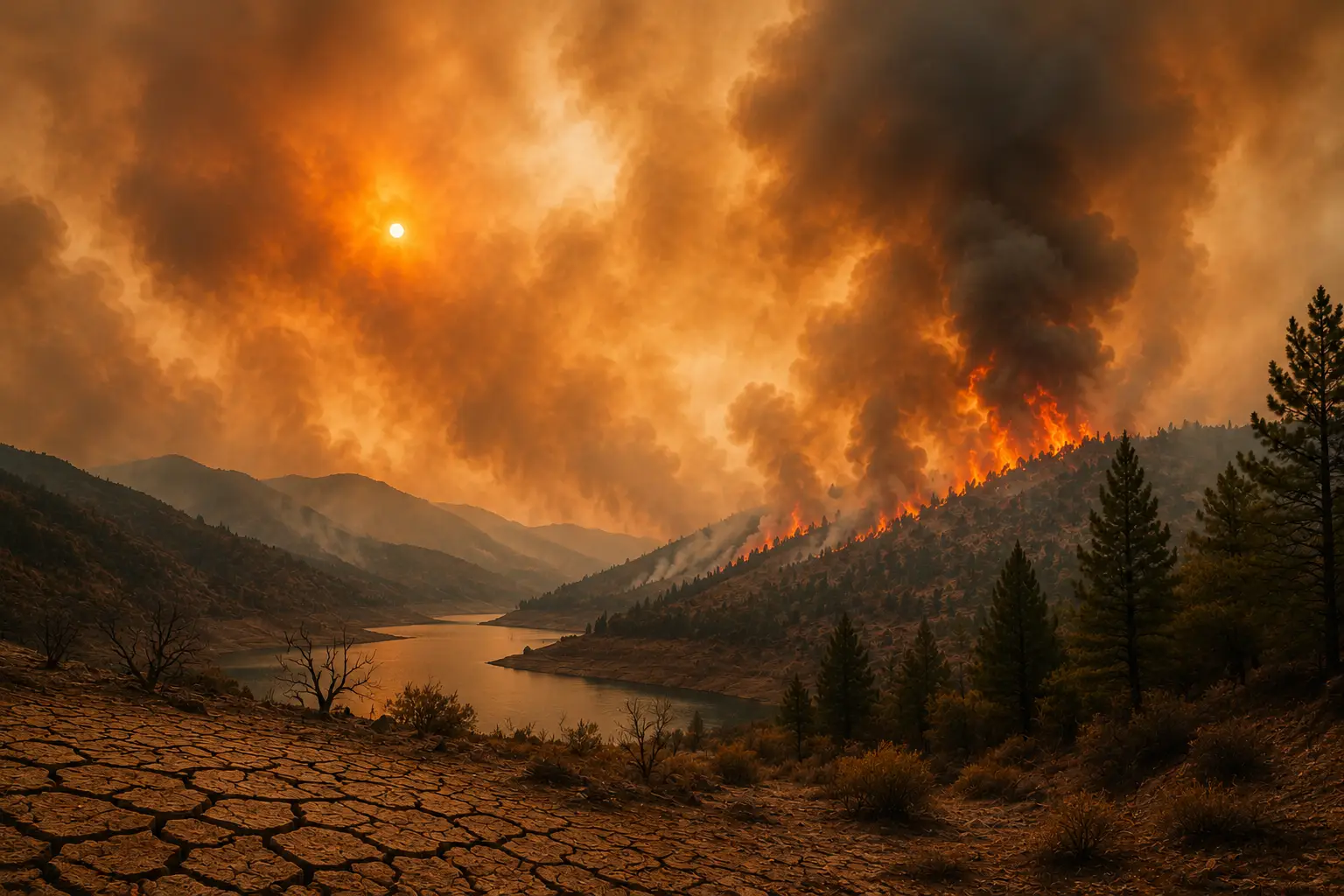
Grand Junction is where I grew up. I lived in the Grand Valley for the better part of two decades before I moved away in 2013, and I honestly cannot remember the smoke ever settling into the valley the way it does now. If a fire flared up somewhere in the high country, you might smell it for an afternoon, and the wind would carry it off by morning. The Book Cliffs were always right there on the edge of town, sharp against the sky, the way they had been my whole life.
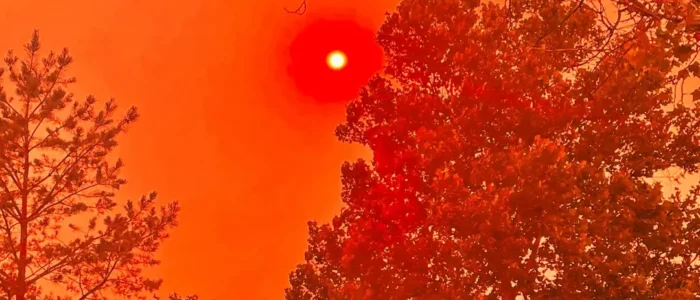
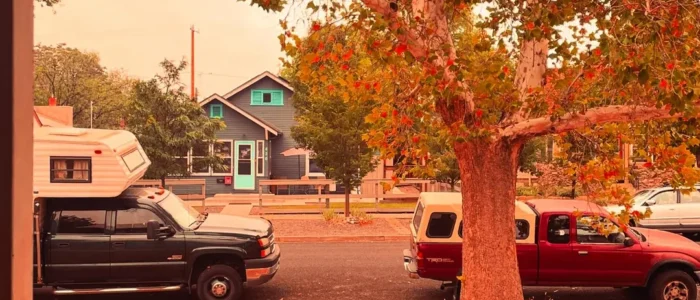
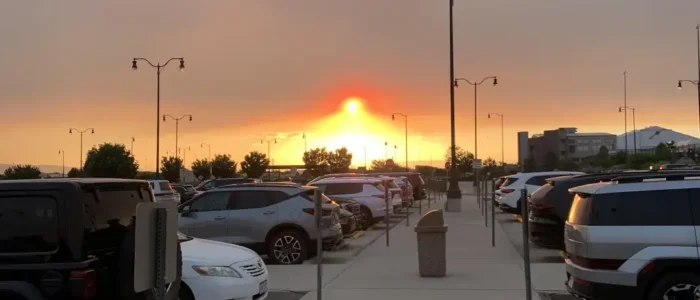
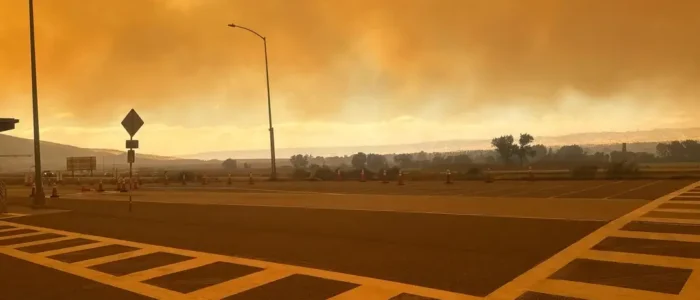
This past week, friends and family back home tell me they cannot see the Book Cliffs at all. The valley is full of smoke. The air is thick enough to taste. People are waking up to a red sky and a haze that does not lift, and the public health department is telling kids, older folks, and anyone with asthma or a bad heart to stay inside in the middle of summer.
That is not the valley I remember. And it turns out my memory is not the problem. The numbers say something has changed, and they say why.
What is actually burning right now
Start with the fire everyone is breathing. The Cottonwood Fire is burning in southern Utah, about five miles east of the town of Beaver in the Fishlake National Forest. It started on June 22 and has already grown to roughly 93,000 acres with zero containment, which makes it the largest active wildfire anywhere in the United States right now. It tore through the Eagle Point ski resort and burned cabins that families had passed down for generations. Utah’s governor has said there is a very good chance it is already the most destructive fire in the state’s history. Investigators have ruled out a natural cause and say it was started by people, though the exact source is still under investigation.
That is the smoke machine. The plume from Cottonwood and a cluster of other Utah and Nevada fires has been blowing east across the Rockies for days, and a lot of it is settling right on top of the Grand Valley.
But Cottonwood is not the only fire that matters to Grand Junction, because some of them are burning in Mesa County itself. The Snyder Mesa Fire started in eastern Utah and crossed the state line into Colorado, burning near Fruita and Glade Park, just west of town. It has grown past 28,000 acres and is completely uncontained. Three wildland firefighters were killed and two more were injured fighting that complex of fires over the weekend. Closer to town, the South Shale Fire kicked up about 14 miles north-northeast of Grand Junction, and after a round of dry lightning, fire crews reported responding to roughly eight new starts in a single 24-hour stretch. To the northeast, the Dry Creek Fire forced evacuations near Rifle along the Interstate 70 corridor.
Step back and the scope gets worse. Utah alone has been fighting around ten large fires burning more than 150,000 acres combined. Nationally, the count stood at more than 35,000 wildfires and about 2.9 million acres burned by late June, which is already running ahead of the ten-year average for this point in the year. The National Weather Service office in Salt Lake City issued its first-ever “particularly dangerous situation” red flag warning. Both Colorado Governor Jared Polis and Utah Governor Spencer Cox have declared emergencies, Polis has authorized the National Guard, and Utah has restricted Fourth of July fireworks because the landscape is too dry to risk a spark.
In Grand Junction, the air quality index climbed above 150 on June 24, which the EPA classifies as flat-out unhealthy for everyone, not just sensitive groups. Mesa County Public Health issued an air quality alert. The state has kept much of western Colorado under a wildfire smoke health advisory, with officials warning that the smoke is at unhealthy levels any time visibility drops below five miles. The BLM put fire restrictions in place across its Grand Junction Field Office. This is happening in June. Hold onto that.
“But we have always had fires in the West”
I know the pushback, because I grew up around it. Fire is part of the West. It always has been. Nobody who has lived in western Colorado thinks wildfire was invented this decade, and I am not going to insult anyone’s intelligence by pretending otherwise.
So let me be fair about it. Yes, the Grand Valley has seen smoke before, and it has seen big fires. The difference is the scale, the frequency, and the calendar.
The worst smoke event most people in Grand Junction can remember is the Pine Gulch Fire in 2020. Lightning started it about 18 miles north of town, and it burned more than 139,000 acres. For a stretch that summer it was the largest wildfire in recorded Colorado history. It dropped ash on cars in town, blotted out the Book Cliffs, and pushed particulate pollution to levels the valley had never measured before, day after day. People described a smoke so heavy you could taste it sitting in your own driveway.
Here is the part that matters for the argument. Pine Gulch was a real, documented, record-setting event, and it happened after I left in 2013. It started on July 31. The same season, the Cameron Peak Fire burned almost 209,000 acres and the East Troublesome Fire exploded from 19,000 acres to 170,000 in roughly a day and a half, becoming two of the largest fires in state history within months of each other. Then in 2025, the Lee Fire in Rio Blanco County burned more than 138,000 acres.
So when I say I do not remember the valley getting socked in like this, I am being honest about a real shift. The era of Grand Junction choking on smoke for days at a time is recent. It did not define summer when I was a kid here. It does now. And the fire blanketing the valley this week started more than a month earlier in the calendar than Pine Gulch did. The season is not just getting worse. It is getting longer.
The damning part: this is climate change, and here is how we know
It would be easy to wave at all this and call it weather. The harder, and more honest, thing is to look at what the science actually says, because the science is not vague and it is not new.
In 2016, two researchers, John Abatzoglou and Park Williams, published a study in the Proceedings of the National Academy of Sciences that put hard numbers on the question. They found that human-caused climate change was responsible for more than half of the increase in “fuel aridity” across western U.S. forests since the 1970s, and that it had doubled the total forest area burned in the West since 1984. Doubled. They also found that warming added an average of nine extra days per year of high fire potential and stretched the fire season longer. That study is now nearly a decade old, and everything since has confirmed it.
The mechanism is not complicated, which is what makes it so hard to argue with. Warmer air acts like a sponge. The hotter it gets, the more moisture the atmosphere pulls out of living trees, dead brush, grass, and soil. Scientists call that vapor pressure deficit, but you do not need the term to understand it. You dry out the fuel, and the fuel burns hotter, faster, and more completely. Researchers have found that across the dry West, how much burns in a given year tracks more closely with how thirsty the air is than with how much rain or snow fell. Average temperatures in the forested parts of the West have risen about 2.5 degrees Fahrenheit since 1970. On Colorado’s Western Slope specifically, federal temperature records show warming of roughly 4 degrees Fahrenheit above pre-1900 levels. That is not a rounding error. That is the difference between brush that smolders and brush that detonates.
Now layer on the water. The Colorado River Basin, which includes western Colorado, has been gripped by what scientists call a megadrought since 2000. In 2022, a study in the journal Nature Climate Change concluded it was the driest 22-year period the region had seen in at least 1,200 years, going back to the year 800. The same study found that about 42 percent of the drought’s severity was directly attributable to human-caused warming. The researchers were blunt about it: without the warming, the drought probably would have broken in the mid-2000s when a couple of wetter years came through. The heat is what kept it going and made it historic.
This is the chain the scientists laid out years ago, and you can watch it play out in this single fire season. Utah just came off its warmest winter on record and its lowest snowpack on record. The snow peaked about three weeks early and melted off, leaving the soil and vegetation to bake through the spring. Parts of the Wasatch got less than a quarter of their normal snow. By the time these fires lit, fuel moisture readings were sitting between 2 and 8 percent, with single-digit humidity and wind gusts around 45 miles per hour. Utah’s own state forester said the fires were spreading under conditions that defy historical expectations, in ways the state had not seen before. That is not bad luck. That is a forecast coming true.
“Isn’t this just El Niño, or a natural cycle?”
This is the objection I take most seriously, so I want to answer it straight instead of dodging it.
Natural climate cycles are real. They have always been real. The big one people point to is the El Niño and La Niña pattern in the Pacific, which shifts our weather from year to year. And this past winter did lean toward La Niña conditions, which tend to dry out the Southwest. So it is fair to say that a natural pattern helped set up a dry winter. I will not pretend it played no part.
But here is where the “it’s just El Niño” line falls apart. El Niño, the other half of that cycle, actually tends to bring more moisture to the Southwest, not less. So if this had been an El Niño winter, it likely would have helped us, not hurt us. Blaming El Niño for a fire season gets the science backwards.
More importantly, La Niña is not new either. Five of the last six winters have leaned that way. These cycles have come and gone over the West for thousands of years without burning down ski resorts in June. What is different now is the baseline underneath them. The same La Niña winter that might have just been dry forty years ago now lands on a landscape that is several degrees hotter, with snow that vanishes weeks early and air that pulls the moisture out of everything. Natural variability sets the stage. The warming is what turns a dry year into a record-breaking, town-threatening one. Recent work out of CU Boulder, published in 2025, even found that human emissions are driving the region’s drought more directly than scientists had previously understood.
So no, you cannot pin this on a Pacific Ocean cycle and walk away. The cycle is the weather. The trend is the climate. And the trend is going one direction.
While we are at it, the other common deflection is forest management, the idea that this is all about not raking the forest or not thinning enough. Fuel management matters, and I will get to it in the solutions, because it is part of the answer. But it is not the whole answer, and it is not honest to pretend it is. A lot of what is burning right now is high desert shrub and dry timber driven by drought, heat, and wind, not just overgrown forest. No amount of thinning makes a landscape fireproof once it has lost its snowpack and the air is sucking it dry. Management is something we control. The aridity is something we are causing.
What this is actually doing to people
I want to bring this back down out of the data, because the whole reason this matters is what it does to regular people.
When the air quality index sits above 150, that is not an abstraction. That is the public health department telling parents to keep their kids indoors. It is older adults and people with COPD, asthma, or heart conditions being told their own neighborhood air is dangerous to breathe. It is summer, in a working town, where plenty of people do not have the option to clock in from a sofa. You cannot tell a roofer, a farmworker, a landscaper, or a guy running a paving crew to simply limit his outdoor exertion. He has bills. He goes out in it, and he breathes it, because the alternative is not getting paid.
That is the part that gets buried in the politics. Wildfire smoke is loaded with fine particulate matter that lodges deep in the lungs and gets into the bloodstream. The people who eat the most of it are the people working outside to keep the rest of us running, and the kids and elderly who cannot fight it off. Three firefighters are already dead this season fighting these fires. Families have lost cabins that held a lifetime of memories. A ski resort and the town economy around it have taken a hit that will outlast the smoke.
This is what the failure to deal with climate change looks like when it finally shows up at your door. It does not arrive as a chart. It arrives as a red sky over your hometown and a warning not to let your kids play outside.
What actually helps
I do not write any of this to leave you sitting in the dark feeling hopeless. There is a difference between the things you can do this week to protect your own household and the things we have to do as a country to keep this from getting worse every summer. Both are real. Both matter.
Right now, to protect yourself and your family:
- Track the air before you make plans. The EPA’s Fire and Smoke Map and Mesa County’s real-time air quality page will tell you what you are actually breathing, not just what the sky looks like.
- Keep your windows and doors shut when the smoke is heavy, and set your HVAC system to recirculate instead of pulling in outside air. Go easy on the swamp cooler, since it draws smoke right in.
- Run a real air filter if you have one, or build a cheap and effective box-fan filter at home. Pick one room with few windows and turn it into a clean room where the air stays good.
- If you have to be outside in it, a properly fitted N95 helps. A bandana or a cloth mask does not.
- Check on the neighbors who get hit hardest, the elderly and anyone with a lung or heart condition. A phone call costs nothing.
And then the harder work, the part that actually addresses why the smoke keeps coming back:
The root cause is the warming, and the only thing that touches the root is cutting the emissions driving it. Everything else is treating symptoms. That is not a partisan statement. It is what the fuel-aridity research has been saying for almost ten years.
At the same time, we have to adapt to the West we already live in, because some of this is locked in. That means smarter fuels and forest management where it genuinely reduces risk, building and rebuilding with fire-resistant materials and real defensible space, and funding the firefighting crews and air monitoring we are leaning on harder every year. The crews fighting these fires are doing heroic work, and three of them just died doing it. They deserve resources, not budget fights.
Most of all, it means our leaders treating this as the recurring emergency it now is, instead of acting surprised every June. We were warned. The science was published in 2016. Pine Gulch was 2020. The bill has been arriving in installments for years. Prevention has always been cheaper than what we are paying now in lungs, in homes, and in lives.
The valley is worth it
I would not call Grand Junction home anymore. I have been gone too long for that. But it is still the place I know best, the one I measure everywhere else against. The mesas, the rivers, the orchards down in Palisade, the Book Cliffs standing guard over town. I still have family there, breathing this same air. So when the valley disappears behind a wall of smoke, it is not an abstraction to me.
What is happening this week is not a freak event, and it is not going to stay rare on its own. The data is clear that it gets worse unless we deal with what is causing it. The people back home breathing this air did not cause the warming, and they are paying for it first. The least the rest of us can do is stop pretending we do not know why the sky turned red.